
01
STAGE
Source & receive
Qualified high-tenacity yarn waste is sourced through dependable domestic and international networks.
Manufacturing process
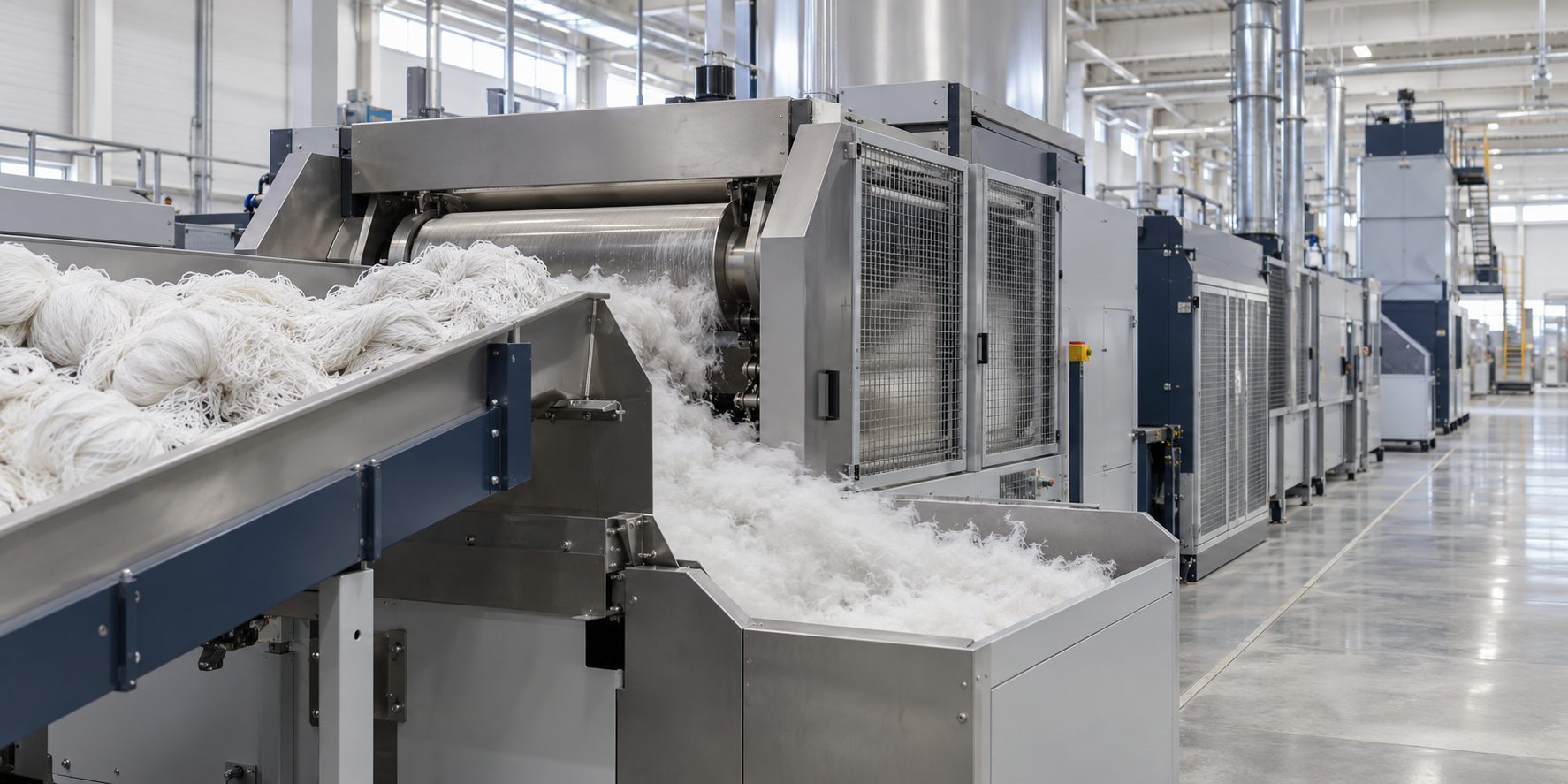
Eight distinct stages convert selected polyester and nylon tire cord and filament yarn waste into garnetted fibre.
Process at a glance
The sequence covers raw-material receipt, preparation, mechanical opening, inspection and packing for polyester and nylon.
Qualified high-tenacity yarn waste is sourced through dependable domestic and international networks.
Polyester and nylon inputs are identified and kept in their relevant material streams.
Unsuitable matter and visibly contaminated material are removed before processing.
Accepted yarn waste is cut into shorter, processable lengths.
Prepared material is fed into the garnetting line in controlled batches.
Metallic-wire surfaces progressively open the prepared yarn waste.
The opened output is reviewed for fibre formation, softness and visible consistency.
Finished fibre is compressed into bales or packed in suitable polypropylene woven packaging.
The complete journey
Material identity is protected through segregation, controlled preparation and dedicated polyester or nylon processing.
Selected high-tenacity polyester, Nylon 6 and Nylon 66 tire cord or filament yarn waste is sourced and received with supplier, quantity and material details.
The required material is separated from unsuitable waste. Polyester and nylon remain distinct and are not processed as a mixed fibre stream.
Visible contamination, foreign material and pieces unsuitable for machine processing are identified and removed before cutting.
Sorted yarn waste is cut into shorter lengths so it can move consistently through the garnetting machinery.
The cut material is loaded into the processing line while maintaining the separation between polyester and nylon categories.
Loaded material passes through progressively finer metallic-wire garnetting surfaces. These stages open and separate the yarn waste into a more fibrous structure.
The opened material reaches fibrous form and becomes garnetted polyester or garnetted nylon fibre. Appearance and batch condition are reviewed.
Finished fibre is packed as compressed bales in suitable PP woven packaging, then prepared for storage and coordinated customer dispatch.
Choose the enquiry that matches your requirement.
I want to buy garnetted fibreI want to offer raw materialCall +91 99910 40057